Medium density 2 lb foam
Closed Cell Spray Foam Insulation in Guelph
Super Sprayers sprays closed cell foam in basements, attics, barns, shops and commercial buildings across Guelph and the surrounding towns, and it makes up the bulk of the more than 800 jobs we have completed since 2018. This page is about the material itself: what it is, where it earns its higher price and how it has to be installed to perform. If you already know which part of the building you want insulated, our application pages cover each space in detail.
Closed cell foam is the densest spray foam used in buildings, and in Ontario's climate it is the one that does the heaviest lifting. It insulates, air seals and controls vapour in a single layer, and it tolerates the moisture found on concrete, steel and roof sheathing. That combination is why it is our default choice below grade and anywhere a cold surface meets warm indoor air.
Because the foam is made on site as it leaves the gun, the result depends entirely on the installer. Our crews are CUFCA certified and follow the CAN/ULC-S705.2 installation standard, which covers mixing ratios, temperatures, pass thickness and daily field checks. Every job also carries our 2-year labour warranty and is covered by WSIB and liability insurance.
- In business since 2018
- 800+ jobs completed
- WSIB covered, licensed and insured
- 2-year labour warranty
- 5-star Google rating
What Closed Cell Spray Foam Is
Closed cell foam is a medium density polyurethane, about 2 lb per cubic foot, whose cells are sealed shut. Those closed cells trap a blowing agent that resists heat flow better than air. The result is a rigid layer with an aged R-value of roughly R-6 per inch, depending on the product.
In Canada the material is covered by the CAN/ULC-S705.1 standard, and installation by CAN/ULC-S705.2. Long-term R-values are tested under CAN/ULC-S770, which is the number worth comparing between products.
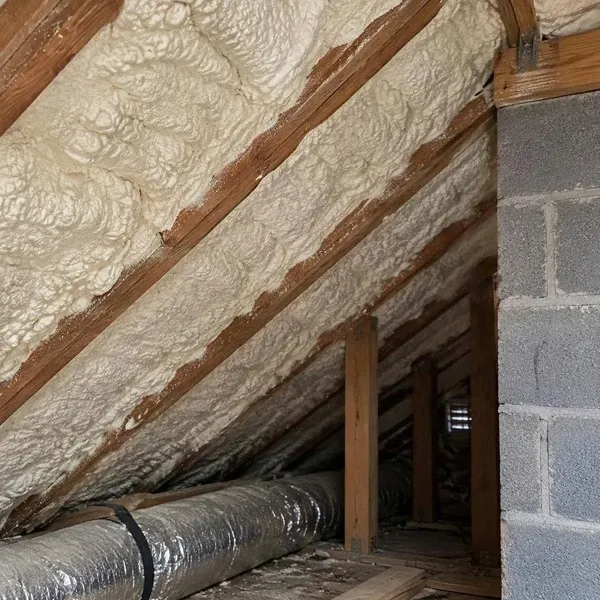
Where Closed Cell Is the Right Choice
| Location | Why closed cell |
|---|---|
| Basement walls | Controls condensation on cold concrete and needs no separate poly |
| Rim joists | Air seals the leakiest joint in the house |
| Roof decks and cathedral ceilings | Keeps sheathing warm in an unvented roof |
| Metal buildings and containers | Bonds to steel and stops it sweating |
| Shallow 2x4 walls | About R-21 in a 3.5 in cavity versus R-12 to R-14 for batts |
| Under slabs | Load-rated high density versions handle concrete |
Vapour Control and Moisture Resistance
At about 2 inches thick, closed cell foam has a low enough vapour permeance to act as the vapour barrier the Ontario Building Code asks for. That means no separate polyethylene sheet on basement walls or roof assemblies sprayed to that depth. Fewer layers also means fewer places for trapped moisture to hide.
Closed cell is water resistant, but it is not a waterproofing membrane. If water is coming through a foundation, that has to be fixed first.
Spraying in Lifts: Why Pass Thickness Matters
The chemical reaction that makes the foam also makes heat. Each pass, called a lift, has a maximum thickness set by the manufacturer, commonly around 2 inches, and the foam has to cool before the next one goes on. Three inches of closed cell is usually two passes, not one.
We track lift thickness and cooling time as part of our S705 records, along with the mix ratio and substrate temperature.
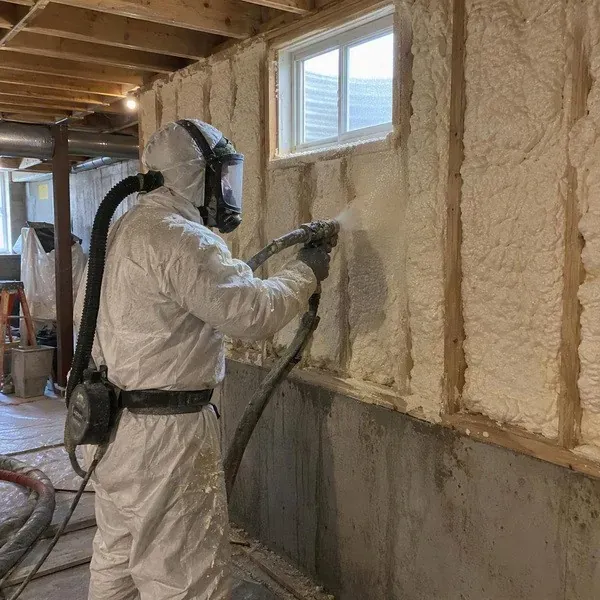
The Foam Systems We Spray
We spray closed cell systems evaluated by the Canadian Construction Materials Centre (CCMC) and listed for use under CAN/ULC-S705.1. Current systems use HFO blowing agents, which have a far lower global warming potential than the HFC blowing agents used in older foams. Product data sheets and CCMC listings for the exact system on your job come with your quote.
Closed Cell Pricing
Closed cell is priced per board foot, which is one square foot at one inch thick. In 2026 installed pricing in our area typically runs about $1.65 to $2.65 per board foot, so 2 inches on a basement wall lands around $3.30 to $5.30 per square foot. See the spray foam cost guide for full examples.
Closed Cell Foam Questions
How thick does closed cell need to be to act as a vapour barrier?
About 2 inches of medium density closed cell foam meets the vapour barrier requirement in most assemblies. We confirm the figure for the specific product on your job.
Is closed cell spray foam waterproof?
It is water resistant and won't soak up water like batts, but it is not a waterproofing membrane. Liquid water leaks need to be repaired before foam goes on.
What R-value does closed cell give per inch?
Roughly R-6 per inch aged, depending on the product. Our R-value guide shows how many inches you need for each target.
Related Services and Resources
- Open Cell Spray Foam Lower cost per inch and quieter rooms above grade.
- Open Cell vs Closed Cell Which foam belongs where, and why.
- R-Value Guide R per inch, Ontario targets and R-60 attics.
- Basement Spray Foam Warmer floors and no more damp, musty corners.
- Rim Joist Insulation Seal the leakiest spot in the house in one morning.
Free estimate
Get a Closed Cell Spray Foam Quote
Tell us where the foam is going and roughly how much area. We'll recommend a thickness and quote it in writing.
- Call or text226-780-8752
- Emailinfo@supersprayers.ca
- Mon to Sat: 7:00am to 9:00pmSun: 9:00am to 6:00pm