A decision guide
Open Cell vs Closed Cell Spray Foam for Ontario Buildings
Closed cell spray foam is dense, rigid and gives about R-6 per inch while blocking air and vapour, which makes it the right choice below grade, against roof decks, on steel and in shallow walls. Open cell foam is soft, cheaper per inch and better at absorbing sound, but at about R-3.6 per inch it needs a separate vapour barrier and should stay out of damp spaces. In Ontario's climate, closed cell does most of the heavy lifting.
That's the short version. This guide from the certified installers at Super Sprayers explains why, with a side-by-side comparison, a room-by-room table and the reasons Canadian conditions push the decision toward closed cell more often than American websites suggest. We install both foams across Guelph, Waterloo Region and Wellington County every week, so there's no reason for us to favour one over the other, and we'll happily talk you out of the more expensive option when it isn't needed.
If you're comparing quotes that specify different foams, this guide will also help you understand why the prices differ so much and whether the cheaper option will actually do the job in your space. Two quotes can look similar on paper and perform very differently after the first winter.
- In business since 2018
- 800+ jobs completed
- WSIB covered, licensed and insured
- 2-year labour warranty
- 5-star Google rating
The Short Answer
Both foams air seal. The difference is what else they do. Closed cell adds vapour control, moisture resistance and rigidity, while open cell adds sound absorption and lower cost per inch.
Rule of thumb: if the space is below grade, touches steel, sits against a roof deck, gets damp or has less than 4 inches of cavity depth, use closed cell. If it's a dry, heated, above-grade cavity where sound matters or depth is generous, open cell with a vapour barrier can work well.
Side-by-Side Comparison
| Property | Closed cell | Open cell |
|---|---|---|
| Density | About 2 lb per cubic foot | About 0.5 lb per cubic foot |
| R-value per inch | About R-6 (aged) | About R-3.5 to R-3.8 |
| Vapour permeance | Low; acts as a vapour barrier at about 2 in | High; needs a separate vapour barrier |
| Expansion | About 30 to 40 times | About 100 times |
| Cost per inch | Higher (about 3x) | Lower |
| Sound absorption | Limited | Good |
| Water resistance | High | Low; absorbs water |
| Rigidity | Rigid; adds stiffness | Soft and flexible |
| Canadian standard | CAN/ULC-S705.1 | CAN/ULC-S712.1 |
Which Foam Goes Where
| Part of the building | Our pick | Why |
|---|---|---|
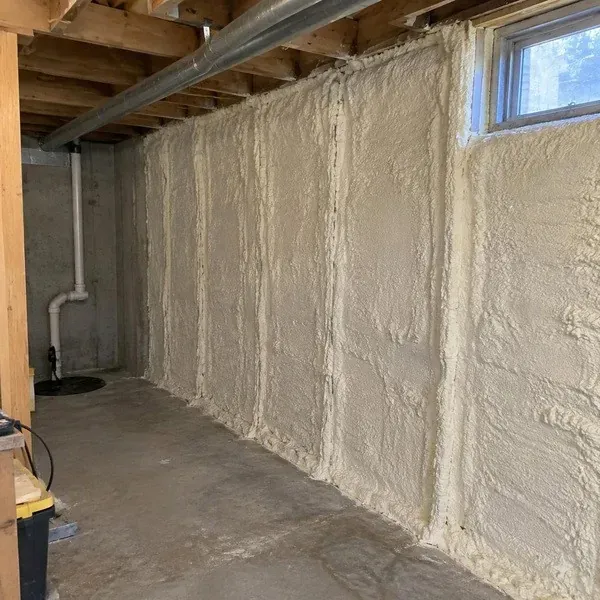
| Basement walls | Closed cell | Controls condensation on cold concrete |
| Rim joists | Closed cell | Air seals and resists moisture |
| Unvented roof or cathedral ceiling | Closed cell | Keeps sheathing warm |
| Metal buildings and barns | Closed cell | Bonds to steel and stops sweating |
| 2x4 exterior walls | Closed cell | Most R-value in a shallow cavity |
| 2x6 exterior walls | Either | Open cell with poly works in dry heated walls |
| Interior walls and floors | Open cell | Sound absorption at lower cost |
| Crawl spaces | Closed cell | Tolerates damp conditions |
Why Closed Cell Dominates in Canadian Climates
In a cold climate, warm indoor air carries moisture outward toward cold surfaces all winter long. Open cell foam lets that vapour through, so it can condense on the cold sheathing or concrete behind it. That's why it always needs a vapour barrier on the warm side.
Closed cell stops the vapour itself and keeps its inner face warm, so the condensation point moves inside the foam where there's no air to condense. Much American advice favours open cell because many U.S. climates are milder, with very different vapour drive.
Using Both in One Project
Many of our projects use both. A typical renovation might get closed cell on the basement walls and rim joists, closed cell on the exterior walls, and open cell between floors and in bathroom walls for sound. Using each foam where it works best often costs less than using closed cell everywhere.
See our closed cell and open cell pages for how each is installed.
Comparison Questions
Which is better for an Ontario attic roofline?
Closed cell. In an unvented roof, the foam has to keep the sheathing warm enough to avoid condensation, and closed cell does that in far less depth.
Is closed cell worth the extra cost?
Where moisture, vapour control or limited depth matter, yes. In dry interior walls where sound is the goal, open cell usually gives better value.
Related Services and Guides
Free estimate
Get Advice for Your Project
Tell us where the foam is going and we'll tell you which one we'd use and why, with a written quote.
- Call or text226-780-8752
- Emailinfo@supersprayers.ca
- Mon to Sat: 7:00am to 9:00pmSun: 9:00am to 6:00pm