No renovation required
Injection Foam Insulation for Existing Walls in Guelph
Super Sprayers insulates closed walls in older homes across Guelph, Kitchener, Cambridge and the surrounding towns using injection foam, a low-pressure foam designed to fill an existing wall cavity through a series of small holes. Since 2018 we have completed more than 800 insulation jobs, and injection foam is the answer for owners who want warmer rooms but have no intention of gutting a house they have just finished decorating.
Many houses built before the 1960s were built with empty wall cavities, and plenty of homes from the decades after that have walls where the original insulation has slumped down to the bottom plate. Those walls feel cold to the touch in winter, outlets on them leak drafts, and the rooms behind them never quite get comfortable no matter how high the thermostat goes.
Injection foam fills the cavity from bottom to top without removing drywall, plaster or siding. The catch is that not every wall qualifies, and the most common failure is a hidden void behind blocking that nobody checked for. Our installers are CUFCA certified and WSIB covered, and we inspect every wall before we quote so you know exactly what you are paying for and which walls will benefit.
- In business since 2018
- 800+ jobs completed
- WSIB covered, licensed and insured
- 2-year labour warranty
- 5-star Google rating
When Injection Foam Makes Sense
- Wood-framed walls with empty or mostly empty cavities
- Cold exterior walls in rooms you don't want to renovate
- Older homes with plaster you want to keep
- Siding replacement, where holes can be drilled from outside first
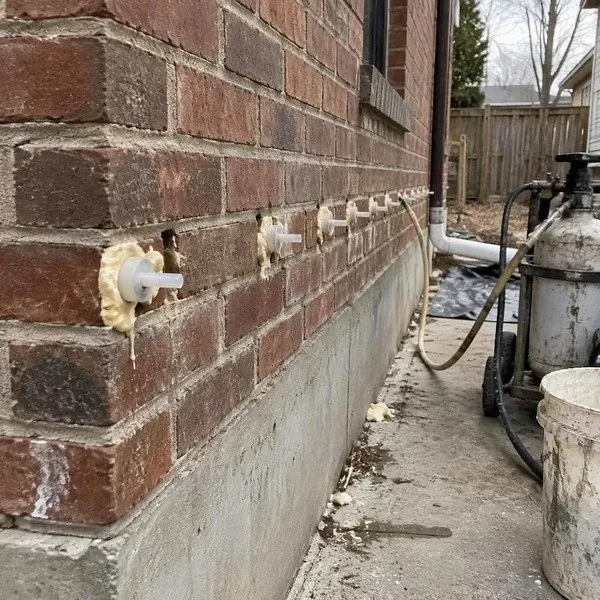
- Brick veneer homes where drilling through mortar joints is possible
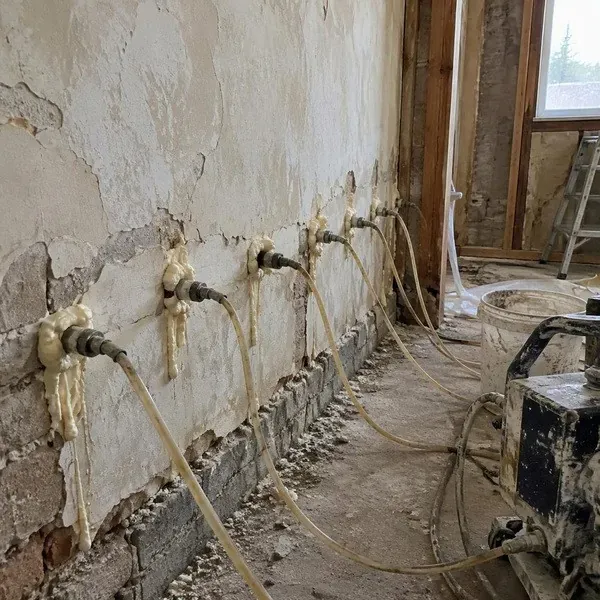
How Injection Foam Is Installed
- 1
Scan the wall
We locate studs, blocking, wiring and existing insulation with a stud finder, borescope and thermal camera.
- 2
Drill access holes
Small holes go in each stud bay, from inside or outside depending on the finish.
- 3
Fill at low pressure
Foam is injected from the bottom of each bay upward until it reaches the top hole.
- 4
Check for voids
Thermal imaging and test holes confirm each bay is full.
- 5
Plug and patch
Holes are plugged and patched, ready for paint or re-siding.
Checking Your Walls First
Before we quote, we look inside the wall. Knob-and-tube wiring must be replaced by an electrician first, since insulation can't surround it. Existing insulation, even slumped, limits how much foam can go in.
Older homes often have balloon framing, where stud bays run from the basement to the attic. Those bays have to be blocked at the top and bottom before filling, or the foam simply disappears.
The most common failure: horizontal fire blocking halfway up the wall stops foam rising into the upper part of the bay. If nobody drills above the blocking, the top half of the wall stays empty and cold.
Injection Foam vs Dense-Pack Cellulose
Both fill closed walls. Here's how they compare.
| Factor | Injection foam | Dense-pack cellulose |
|---|---|---|
| Air sealing | Very good | Good |
| R-value per inch | About R-4 to R-5 | About R-3.5 to R-3.8 |
| Settling | None | Minimal when dense-packed correctly |
| Hole size | Small | Larger |
| Cost | Higher | Lower |
Dense-pack cellulose is often the better value on large wall areas. Our blown-in insulation page covers it.
Solid Masonry and Double-Brick Walls
Many century homes in Guelph and Kitchener have solid double-brick or stone walls with no stud cavity at all. There's nothing for injection foam to fill. Some brick veneer homes do have a cavity behind the brick, and we can check with a test hole.
Solid masonry walls need a different strategy, covered in our older and stone homes guide.
Timeline and Cost Factors
Most homes take one to three days depending on the number of walls. Price depends on total wall area, whether we drill from inside or outside, how much blocking needs extra holes and the finish repair required. We quote by wall area once we've scanned the house.
Injection Foam Questions
Can walls be insulated without removing drywall?
Yes. Injection foam and dense-pack cellulose both go in through small holes, with no drywall removal.
Will injection foam damage my walls?
Low-pressure injection foam is designed for closed walls and doesn't push drywall or plaster off the studs when installed correctly. We fill slowly and watch every bay.
Do you drill from inside or outside?
Either. Outside works well when siding is coming off anyway or through brick mortar joints, and inside works when the exterior must not be touched.
Related Services and Resources
Free estimate
Find Out if Your Walls Qualify
Tell us the age of the house, the wall finish and the exterior cladding. We'll scan the walls before we quote.
- Call or text226-780-8752
- Emailinfo@supersprayers.ca
- Mon to Sat: 7:00am to 9:00pmSun: 9:00am to 6:00pm